

English1
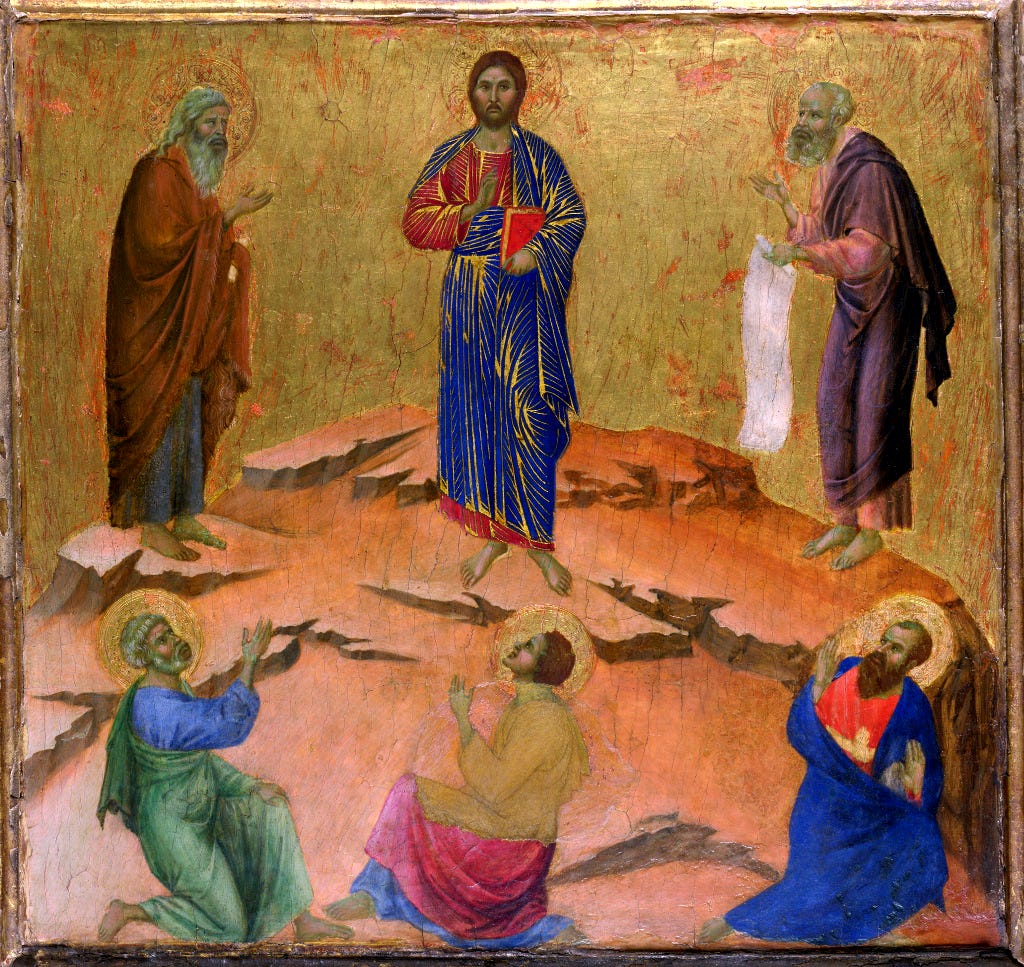
Onze Heer neemt de Heilige Apostelen Petrus, Jakobus en Johannes mee naar een hoge berg, weg uit het rumoer van de wereld, de stilte in, om hun ogen te openen voor het ontoegankelijke Mysterie van Gods heerlijkheid, dat in Christus midden in de wereld aanwezig is (vgl. Matteüs 17,1; Johannes 1,14; Lucas 9,28).
Terwijl Jezus bidt (vgl. Lucas 9,29), “begint Zijn gelaat te stralen als de zon en wordt Zijn kleed glanzend als het licht” (Matteüs 17,2).
Wat gebeurt hier?
Jezus ontvangt op de berg geen heerlijkheid van de Vader die Hij tevoren niet bezat. Reeds vóór de kosmos bestond, bezat Hij bij de Vader de heerlijkheid die Hem, Zijn Zoon, van eeuwigheid toekomt (vgl. Johannes 17,5). Wat op de berg gebeurt is dat Hij voor een ogenblik zichtbaar laat worden wat Hij uit liefde verborgen houdt - omwille van ons geloof en ons heil, opdat wij Hem niet gedwongen door het schouwspel, maar vrij in geloof zouden volgen (vgl. Johannes 20,29).
Het wonder is niet slechts dat op de Tabor een glans doorbreekt van het “ontoegankelijke licht” waarin God woont (1 Timoteüs 6,16). Nog groter is het wonder dat God gewoon onder ons leeft als waarachtig mens: als dienaar, als arme, als slaaf. Hij “heeft Zichzelf ontledigd en de gestalte van een slaaf aangenomen” (Filippenzen 2,7); hoewel Hij rijk was, is Hij omwille van ons arm geworden (vgl. 2 Korintiërs 8,9).
Hij kent honger en dorst, vermoeidheid en droefheid; Hij kent onze verlatenheid, angst en lijden (vgl. Matteüs 4,2; Johannes 4,6-7; 19,28; Matteüs 26,37-38; 27,46; Hebreeën 2,18). Toch ontbreekt Hem geen enkele goddelijke macht! Hij is de Pantocrator, de Almachtige (vgl. Apocalyps 1,8). “Ik en de Vader, Wij zijn één” (Johannes 10,30); et Verbum erat apud Deum et Deus erat Verbum - “en het Woord was bij God en het Woord was God” (Johannes 1,1). Hij is van eeuwigheid in de schoot van de Vader en Hij alleen heeft de Vader gezien (vgl. Johannes 1,18; 6,46).
Maar te midden van ons neemt Hij onze zwakheid op Zich en draagt Hij onze ziekten (vgl. Jesaja 53,4; Matteüs 8,17). Hij buigt Zich onder ons kruis om het voor ons te dragen: “Hij heeft in Zijn lichaam onze zonden op het kruishout gedragen” (1 Petrus 2,24). Vrijwillig en gewillig neemt Hij onze menselijke natuur aan en draagt Hij de last van onze gevallen toestand. Hij wordt gehoorzaam “tot de dood, tot de dood aan een kruis” (Filippenzen 2,8). Op de Calvarieberg wordt dat kruis als een lichtbaken opgericht; daar verlost Hij ons van de zonde en uit de macht van de duisternis en de dood (vgl. Kolossenzen 1,13-14; Hebreeën 2,14-15).
Op de Olijfberg, in Getsemane, zal Hij bidden, met het gelaat ter aarde, bedrukt door doodsangst en door de zware last van onze zonden (vgl. Matteüs 26,38-39; Lucas 22,41-44). Op Golgota, de Calvarieberg, zal men Hem beroven van alle uiterlijke schoonheid en van ieder teken van menselijke waardigheid (vgl. Jesaja 52,14; 53,2-3; Filippenzen 2,8). Aan Zijn geschonden gelaat en Zijn gewonde lichaam aanschouwen wij hoe waarachtig en werkelijk Gods liefde voor ons is: “God bewijst Zijn liefde voor ons juist hierdoor, dat Christus voor ons is gestorven toen wij nog zondaars waren” (Romeinen 5,8). En wij weten en geloven: “Niemand neemt Mij het leven af; Ik geef het uit eigen vrije wil” (Johannes 10,18).
Petrus wil drie tenten bouwen. Hij wil het licht vasthouden en op de berg blijven (vgl. Matteüs 17,4; Lucas 9,33). Maar de Vader zegt niet: ‘Kijk naar Hem’; Hij zegt: “Luistert naar Hem” (Matteüs 17,5). Het geloof leeft niet van wat wij eenmaal mochten zien of voelen van God, maar van het luisteren naar en gehoorzamen aan Christus, aan Zijn Woord en aan Zijn Kerk, ook wanneer Zijn heerlijkheid opnieuw verborgen is. “Wij leven in geloof, wij zien Hem niet” (2 Korintiërs 5,7), en: “Wie naar u luistert, luistert naar Mij” (Lucas 10,16).
Daarom daalt de Heer met Zijn leerlingen de berg weer af - de plaats van het gebed (vgl. Matteüs 17,9). Want gebed is geen vlucht uit het leven, maar een ontmoeting die ons leert liefhebben. Wij ontvangen licht om de donkere weg te gaan — “Uw woord is een lamp voor mijn voet en een licht op mijn pad” (Psalm 119,105). Wij ontvangen troost om anderen te troosten (vgl. 2 Korintiërs 1,3-4), en hoop om onder ons kruis trouw te blijven aan Hem die het met ons draagt (vgl. Lucas 9,23; Matteüs 11,28-30).
En wanneer wij met Christus gekruisigd worden (vgl. Galaten 2,19-20), ontvangen wij uit Zijn barmhartigheid de genade om, naar Zijn voorbeeld, onze vijanden te vergeven en te zegenen: “Vader, vergeef hun, want zij weten niet wat zij doen” (Lucas 23,34), en: “Zegent hen die u vervloeken, bidt voor hen die u mishandelen” (Lucas 6,28).
The Lord takes the Apostles Peter, James, and John with Him up a high mountain, away from the noise of the world and into silence, to open their eyes to the inaccessible mystery of God’s glory, present in Christ in the midst of the world (cf. Matthew 17:1; John 1:14; Luke 9:28).
While Jesus is praying (cf. Luke 9:29), “His face shines like the sun, and His clothes become white as light” (Matthew 17:2).
What is happening here?
On the mountain, Christ does not receive from the Father a glory that He did not already possess. Before the world existed, He already possessed with the Father the glory that belonged to Him from all eternity (cf. John 17:5). For a single moment, He merely allows what He has hidden out of love to become visible: for the sake of our faith and our salvation, so that we might follow Him not compelled by the sight of His glory, but freely in faith (cf. John 20:29).
The wonder is not merely that a radiance of the “unapproachable light” in which God dwells breaks through on Mount Tabor (1 Timothy 6:16). An even greater wonder is that He, the Son of God, lives among us as a true man: as a servant, as one who is poor, as a slave. He “emptied Himself, taking the form of a slave” (Philippians 2:7); although He was rich, He became poor for our sake (cf. 2 Corinthians 8:9).
He knows hunger and thirst, weariness and sorrow; He knows abandonment, anguish, and suffering (cf. Matthew 4:2; John 4:6–7; 19:28; Matthew 26:37–38; 27:46; Hebrews 2:18). Yet He lacks no divine power. He is the Pantocrator, the Almighty (cf. Revelation 1:8). “The Father and I are one” (John 10:30); et Verbum erat apud Deum—“and the Word was with God” (John 1:1). From all eternity He is in the bosom of the Father, and He alone has seen the Father (cf. John 1:18; 6:46).
Yet among us He takes our weakness upon Himself and bears our infirmities (cf. Isaiah 53:4; Matthew 8:17). He bends beneath our cross in order to carry it for us: “He Himself bore our sins in His body on the cross” (1 Peter 2:24). Freely He assumes our human nature and bears the burden of our fallen condition. He becomes obedient “to the point of death—even death on a cross” (Philippians 2:8). On Calvary, that cross is raised like a beacon of light; there He delivers us from sin and from the dominion of darkness and death (cf. Colossians 1:13–14; Hebrews 2:14–15).
On the Mount of Olives, in Gethsemane, He will pray with His face to the ground, overwhelmed by mortal anguish and by the heavy burden of our sins (cf. Matthew 26:38–39; Luke 22:41–44). On Golgotha, the hill of Calvary, He will be stripped of all outward beauty and every sign of human dignity (cf. Isaiah 52:14; 53:2–3; Philippians 2:8). In His disfigured face and wounded body, we behold how true and real God’s love for us is: “God proves His love for us in that while we still were sinners Christ died for us” (Romans 5:8). And we know and believe: “No one takes it from Me, but I lay it down of My own accord” (John 10:18).
Peter wants to build three tents. He wants to hold on to the light and remain on the mountain (cf. Matthew 17:4; Luke 9:33). But the Father does not command the disciples to cling to the vision; He says, “Listen to Him” (Matthew 17:5). Faith does not live on what we were once permitted to see or feel, but on listening to and obeying Christ, His Word, and His Church, even when His glory is hidden once more. “We walk by faith, not by sight” (2 Corinthians 5:7), and: “Whoever listens to you listens to Me” (Luke 10:16).
Therefore, the Lord descends the mountain again with His disciples (cf. Matthew 17:9). Prayer is not an escape from life, but an encounter that teaches us to love. We receive light so that we may walk the dark road—“Your word is a lamp to my feet and a light to my path” (Psalm 119:105)—comfort so that we may comfort others (cf. 2 Corinthians 1:3–4), and hope so that we may remain faithful beneath our cross to Him who carries it with us (cf. Luke 9:23; Matthew 11:28–30).
And when we are crucified with Christ (cf. Galatians 2:19–20), through His mercy we receive the grace to forgive and bless our enemies, following His example: “Father, forgive them, for they do not know what they are doing” (Luke 23:34), and: “Bless those who curse you, pray for those who abuse you” (Luke 6:28).